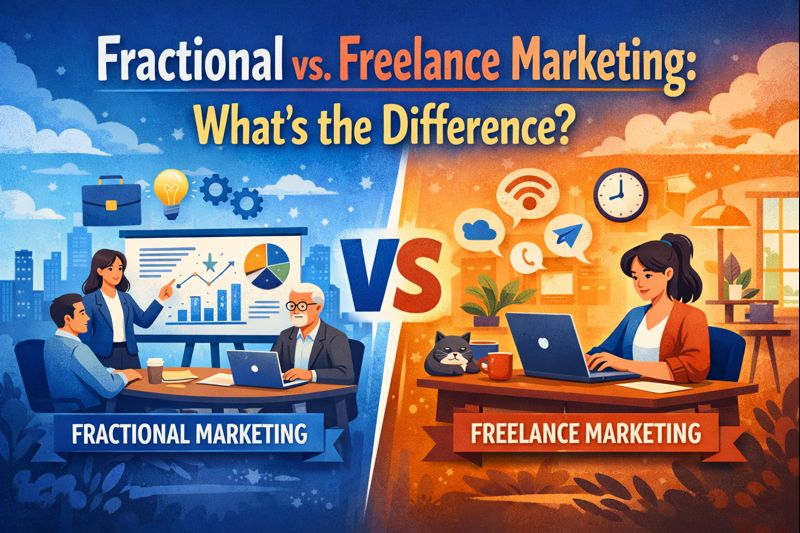
Hiring “marketing help” can mean two very different things: bringing in someone to execute specific tasks, or bringing in someone to lead marketing outcomes across the business. Both options can work. They just solve different problems.
That’s why the fractional vs. freelance question matters so much for startups and growth-stage teams. A freelancer can move fast inside a defined lane. A fractional leader—especially a fractional CMO for venture-backed companies—is there to set direction, make trade-offs, and own the marketing plan across functions, without the commitment of a full-time executive hire.
This listicle breaks down what actually changes between fractional marketing leadership and freelance marketing support, what each model is best for, and how to choose the right fit.
1) The simplest definition: execution vs. ownership
Freelance marketing is usually about execution. You hire a specialist (or generalist) to deliver work you already know you need—ads, content, emails, creative, landing pages, analytics setup, and so on.
Fractional marketing is usually about ownership. You bring in a senior leader part-time to define what should happen next, build a plan, align stakeholders, and steer the team toward business outcomes. They may execute some work early on, but their job is to make sure marketing is moving in the right direction, not just moving.
If your team keeps asking, “What should we do next?” you’re describing a leadership gap, not a production gap.
2) Seniority: specialist support vs. executive leadership
Most freelancers are hired for a specific discipline. They may be excellent, but they’re typically not responsible for the entire go-to-market strategy. That’s not what they’re being paid for.
Fractional marketing leadership is closer to hiring an executive—most often a fractional CMO or interim CMO—who can sit at the leadership table, work cross-functionally, and make calls that affect revenue, hiring, and positioning. For founders, this matters because you’re not only buying marketing work; you’re buying judgement and experience under uncertainty.
Here’s what that difference often looks like in practice:
- A freelancer asks: “What’s the brief, and when do you want it delivered?”
- A fractional leader asks: “What’s the goal, what’s the constraint, what’s the best bet, and what are we not doing this quarter?”
3) The main output: deliverables vs. decisions
Freelancers tend to produce deliverables. Fractional leaders tend to produce decisions that shape all deliverables.
A freelancer might ship:
- A paid campaign build
- A sequence of lifecycle emails
- A batch of blog articles
- A homepage rewrite
- A reporting dashboard
A fractional leader might drive decisions like:
- ICP and segment focus (who you’re really targeting)
- Positioning and messaging hierarchy (why you win)
- Channel strategy and sequencing (what to do first and why)
- Budget allocation (where money should actually go)
- Team structure (who to hire next, what to outsource, what to pause)
- Measurement (what counts as real progress)
That “decisions” list isn’t glamorous, but it’s often the difference between marketing that feels busy and marketing that produces a predictable pipeline.
4) Accountability: task completion vs. outcomes
Freelancers are usually accountable to scope, quality, and deadlines. If you want five landing pages by Friday, a strong freelancer can do that, and do it well.
Fractional leaders are accountable to outcomes—typically in the form of KPIs and progress against a plan. They’ll still care about quality, but their bigger job is to make sure the work ties back to growth targets, the funnel, and what the business needs right now.
For venture-backed teams, this is a major reason a fractional CMO for venture-backed companies can be a better fit than stacking more freelancers. Investors and boards rarely ask how many campaigns you launched. They ask what moved, what didn’t, and what you’re changing next.
5) Scope: lane-based support vs. cross-functional leadership
Freelance scope is usually contained. Even when a freelancer is a “full-stack marketer,” they’re often still operating as a service provider inside a defined set of tasks.
Fractional leadership is designed to cut across the business. Marketing touches sales, product, customer success, ops, analytics, hiring, pricing, and brand. When your marketing problem is really a coordination problem, leadership becomes the lever.
Examples of cross-functional fractional work can include aligning:
- Sales and marketing on definitions (MQL, SQL, pipeline stages)
- Messaging across product, site, decks, and outbound
- Launches with product timelines and sales enablement
- Reporting and attribution with RevOps reality (not vanity metrics)
If marketing is being blamed for the pipeline, but sales follow-up is inconsistent, a freelancer can’t solve that alone. A fractional leader can help set the process and accountability across teams.
6) Time horizon: project delivery vs. quarterly operating rhythm
Freelancers often work best when there’s a clear project or repeating production cadence. If you know what “good” looks like and you just need it done, freelance support is efficient.
Fractional leaders typically operate on a quarterly rhythm: define priorities, allocate resources, run experiments with discipline, review performance, adjust, and repeat. They help create an operating system so marketing doesn’t restart every month.
That’s why fractional leadership can feel “slower” in week one (they ask questions, audit, and reset priorities), but faster by week six (the team stops thrashing and starts compounding).
7) Cost model: cheaper on paper vs. higher leverage
Freelancers are often priced hourly, per-project, or on a small retainer. Fractional leaders are typically on a monthly retainer that reflects leadership value and responsibility.
When people compare costs, they sometimes compare “hourly rate vs. monthly retainer” and stop there. The better comparison is: what does it cost you to run the wrong channel mix for two quarters, or to hire a full-time head of marketing too early, or to scale spend without a real funnel?
Freelance is often the most cost-effective way to execute. Fractional leadership is often the most cost-effective way to avoid expensive mistakes.
8) Best-fit situations for freelance marketing
Freelancers shine when your plan is mostly clear and you need strong hands to execute. You’ll usually get good results from freelance support when you can provide clarity on goals, audience, and what success looks like.
Freelance is a strong fit when:
- You already know which channel(s) to run next
- You have internal leadership to set direction and review work
- You need specialist depth (SEO, paid search, lifecycle, design, analytics)
- You’re running repeatable motions and want incremental improvements
- You’re in a short-term sprint (launch, site migration, campaign burst)
Freelancers can absolutely move the needle—when they’re plugged into a coherent plan.
9) Best-fit situations for fractional marketing leadership
Fractional leadership is most valuable when the problem is prioritisation, direction, and accountability across the funnel. This is where a fractional CMO for venture-backed companies becomes a practical option: executive-level leadership without the delay and commitment of a full-time hire.
Fractional leadership is a strong fit when:
- Marketing feels busy but inconsistent quarter to quarter
- Your ICP and positioning aren’t crisp, so every campaign feels like guessing
- Sales and marketing aren’t aligned on pipeline reality
- You need a credible plan for stakeholders (exec team, investors, board)
- You’re building (or rebuilding) the marketing function and need structure
- You’re about to scale spend and want confidence before you do
In these cases, adding more freelancers often adds more motion, not more clarity.
10) The comparison table: fractional vs. freelance marketing
Here’s a side-by-side view that founders and operators can scan quickly.
| Category | Freelance Marketing | Fractional Marketing Leadership |
| Primary purpose | Execute defined work | Own direction and outcomes |
| Typical profile | Specialist or channel operator | Senior leader (CMO/VP-level) |
| Best for | Production and optimisation | Strategy, prioritisation, cross-functional alignment |
| Success looks like | Deliverables shipped well | Funnel performance improves against a plan |
| Who sets priorities | You / internal lead | Fractional leader (with you) |
| Stakeholder management | Limited | Common (exec team, board, investors) |
| Team impact | Adds capacity | Builds function, process, and accountability |
| Time horizon | Project or lane-based | 30/60/90-day plan + quarterly rhythm |
| Common risk | Great work, wrong direction | Needs access and trust to be effective |
11) What to hire by stage and constraints
Sometimes the “right” answer depends less on stage and more on your constraints (time, clarity, budget, internal bandwidth). This table is a quick guide.
| Your situation | Most common best fit | Why |
| Pre-seed / seed, still finding ICP | Fractional leadership (light) + a few specialists | You need direction and messaging more than volume |
| Series A, pressure to build pipeline | Fractional CMO + demand gen execution | You need a funnel plan, reporting, and a repeatable motion |
| Sales-led with strong sales leader but weak marketing | Fractional leader | Cross-functional alignment is the blocker |
| Strong marketing lead internally, short on hands | Freelancers | Execution capacity is the blocker |
| Channel is known (e.g., SEO) and ready to scale | Freelance specialist | Deep expertise beats general support |
| Confusing results, no clear attribution | Fractional leader + RevOps/analytics support | Measurement and prioritisation come first |
12) A fast decision checklist (no overthinking)
If you want a quick way to decide, use this logic: hire freelance when you have clarity, hire fractional when you don’t.
Choose freelance if most of this is true:
- You can clearly explain the audience, offer, and goal
- You can provide examples of “good” work
- You have someone who can review and guide the work
- You mainly need more execution capacity
Choose fractional leadership if most of this is true:
- Priorities change weekly and no one owns the plan
- Sales and marketing disagree on what’s happening
- Positioning is fuzzy and messaging isn’t consistent
- You need a marketing leader but aren’t ready for full-time
- You need reporting and a narrative stakeholders trust
13) The model many teams end up using: fractional lead + freelance specialists
In real life, many growth teams use both models at the same time. Fractional leadership sets priorities and owns the plan. Freelancers (and/or agencies) execute inside the lanes that matter most.
This blended approach can work especially well for startups because it keeps the team lean while still creating leadership and accountability. It also helps avoid the common trap where founders become the default marketing manager, reviewer, strategist, and QA person—on top of running the company.
If you want curated guides to compare providers and options, these pages from GrowTal are relevant:
14) Common mistakes that make either option fail
Most “bad marketing hire” stories aren’t about talent. They’re about mismatches.
One common mistake is hiring freelancers before strategy is clear. You end up with a pile of assets that don’t add up to pipeline. The freelancer delivered; the business still didn’t grow.
Another is hiring fractional leadership but keeping them at arm’s length—limited access to pipeline data, no sales call recordings, no ability to influence product messaging, no say in priorities. Fractional leaders can’t do leadership work without context and decision power.
A third mistake is expecting one person to fix everything. Freelancers aren’t there to be your CMO. Fractional CMOs aren’t there to be your full production team. The cleanest results come when you match the model to the job.
15) What the first 30 days typically look like
With a freelancer, the first month is usually delivery-focused: onboarding, briefing, asset creation, iteration, and early performance signals. You should expect tangible work quickly, assuming you can provide the inputs.
With fractional leadership, the first month often starts with clarity work: audits, funnel review, messaging and ICP alignment, reporting cleanup, prioritisation, and a 30/60/90-day plan. You may still get quick wins, but the bigger value is reducing noise and creating a system the team can run.
For venture-backed teams, that system is often what turns marketing from “a set of activities” into “a function that can be scaled.”
About GrowTal

GrowTal is a marketing talent marketplace that helps companies hire proven growth and marketing pros—fast. Instead of sorting through endless profiles or rolling the dice on generic contractors, teams use GrowTal to connect with vetted experts who match the specific work they need, whether that’s a fractional marketing leader (like a fractional or interim CMO) or a specialist to execute in a single channel.
For startups and growth-stage teams, GrowTal is useful when you want flexibility without sacrificing quality. You can bring in senior leadership to set strategy and prioritise the right bets, add specialists to run execution, or build a blended setup that scales with your goals. The result is a cleaner path to building a marketing function that’s aligned with revenue, resourced properly, and able to move quickly as the business evolves.
Conclusion
Freelance marketing is typically the right choice when you know what you need and want it executed well. Fractional marketing is typically the right choice when you need leadership, prioritisation, and ownership of outcomes—especially when growth pressure is high and the business can’t afford a quarter of scattered bets.
If your goal is to bring in a fractional CMO for venture-backed companies, treat it as a leadership hire: give access, context, and room to lead. Then use freelancers where they shine—specialist execution inside a clear plan.
FAQs
What is the average hourly rate for a fractional CMO?
Most fractional CMOs fall in the $150–$500/hour range, with many market benchmarks clustering around $200–$350/hour depending on experience, scope, and company stage. The rate is usually higher when the role includes executive-level ownership (strategy, team leadership, revenue accountability) rather than advisory-only support.
What is a fractional CMO for startups?
A fractional CMO for startups is a part-time, senior marketing leader who sets strategy, prioritises channels, aligns marketing with sales/product, and helps build the marketing function—without hiring a full-time exec. It’s commonly used when a startup needs experienced leadership now, but doesn’t want (or can’t justify) a full-time CMO yet.
How much does it cost to hire a fractional CMO?
Most fractional CMOs work on a monthly retainer, often landing in the $5,000–$20,000/month range based on time commitment and scope. Some providers cite common averages around the low five figures per month, with hourly options also available for lighter engagements.
What is the best fractional CMO company?
There isn’t one universal “best”—the right choice depends on your stage, industry, growth model (PLG vs. sales-led), and whether you need strategy-only or strategy + execution management. The best fractional CMO company for you will show a track record in similar businesses, a clear operating cadence (KPIs, reporting, prioritisation), and references that match your goals.