
I recently audited several failed marketing hires. I found a recurring structural failure: founders choose platforms based on volume rather than vetting precision. Every freelancer now claims to be an expert. Because of this, the bottleneck is no longer finding people. It is filtering them. Choosing the wrong platform is a $5,000 gamble that most startups cannot afford.
George Akerlof won a Nobel Prize for describing what happens to a market in exactly this condition. The subtitle of his 1970 paper is the diagnosis:
“Quality Uncertainty and the Market Mechanism”
George Akerlof – “The Market for ‘Lemons’,” Quarterly Journal of Economics, 1970
His case was used cars. Buyers cannot tell a good one from a defective one, so they will only pay an average price. Sellers of genuinely good cars will not accept the average, so they withdraw — and the average quality of what remains falls again. Akerlof called the result adverse selection.
An open freelance marketplace has the same structure. Every profile asserts expertise, the buyer cannot verify it before committing, and the specialists who could command more leave for networks where their quality is legible. Vetting is not a convenience feature on a talent platform. It is the mechanism that stops the market degrading. Choosing the wrong platform is a $5,000 gamble that most startups cannot afford.
The $1.27 Billion Shift to Fractional Talent
Why full-time is no longer the default
The fractional executive market is now valued at $1.27 billion according to Marketing Stockport. Businesses are realizing that full-time hiring leads to a 90-day onboarding lag. This lag is a strategic leak. A fractional leader can start in 48 hours and begin delivering ROI immediately. This shift is not just about cost. It is about accessing elite strategy without a long-term commitment.
The cost of the 90-day onboarding lag
When you hire a full-time executive, you pay for their learning curve. I analyzed the ramp-up time for mid-market B2B firms. I found that most do not produce meaningful results until month four. In contrast, vetted marketing experts are expected to execute from day one. By using technical auditing tools, these specialists can fix funnel leaks quickly. They often finish these tasks before a traditional hire completes their first week of orientation.
Diagnostic: Why Automated Marketplaces Fail Marketing Teams
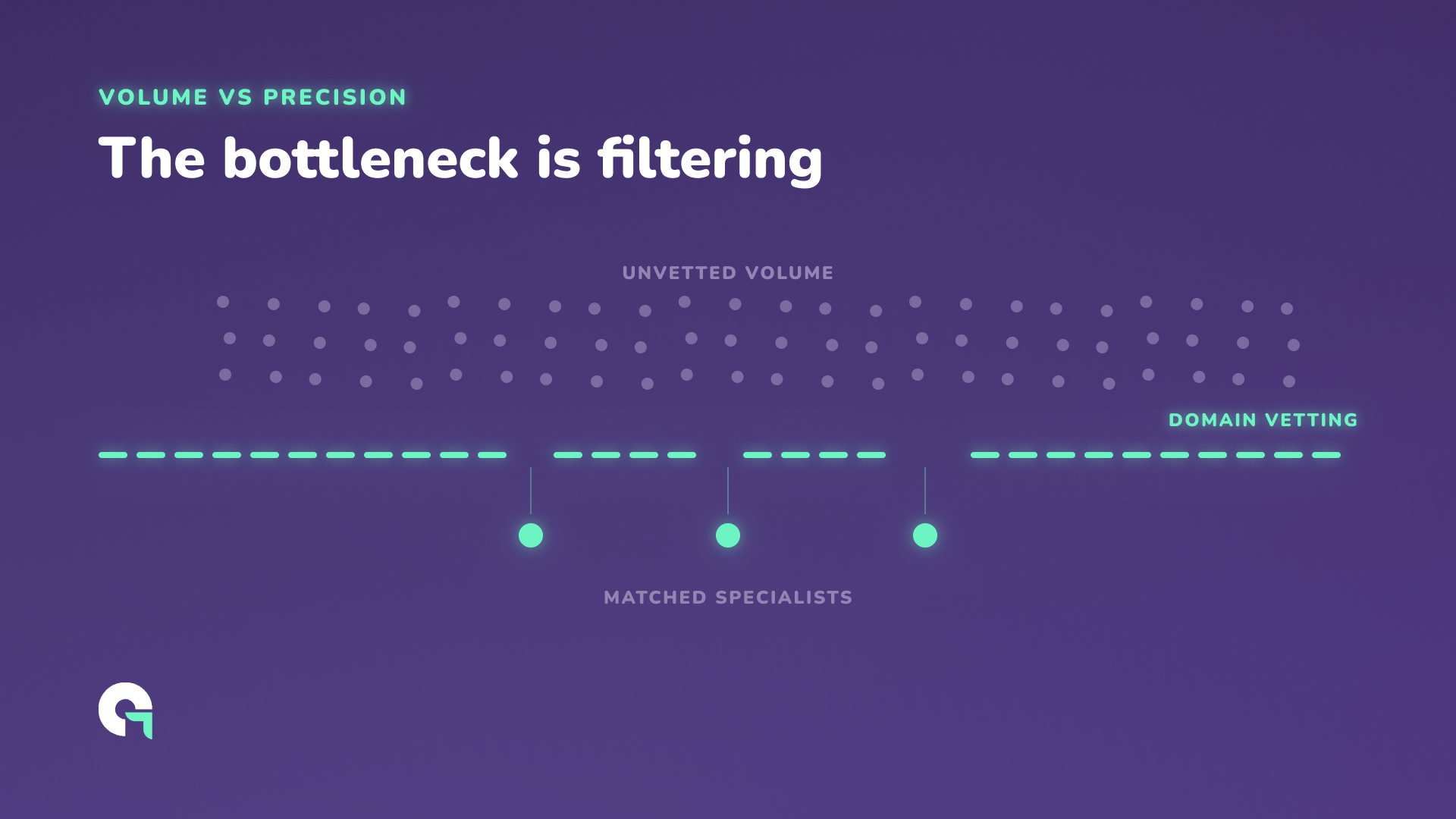
- Lack of domain vetting: Algorithms cannot distinguish between a generalist and a niche expert.
- High management tax: You spend more time managing the freelancer than they spend executing.
- Strategic misalignment: Automated matches often ignore the unit economics of your specific growth stage.
- Zero accountability: Generic platforms offer little recourse when a project fails.
Selection Criteria: The Vetting Markers That Matter
- Manual Advisory Matching: Does the platform use marketing experts to match you with talent?
- Domain-Specific Rigor: Are specialists tested for their niche (e.g., B2B SaaS vs. E-commerce)?
- Integration Support: Does the platform help you brief the specialist to ensure a fast ramp-up?
Readiness by the Numbers
- Hiring Speed: Vetted platforms place talent in 48 hours vs. 4 months for traditional HR.
- Retention: Fractional engagements have a 20% higher success rate due to clear project boundaries.
- Cost Savings: Choosing a curated talent network reduces the hidden overhead of vetting by 30-50%.
What to do next: Auditing Your Sourcing Strategy
- Evaluate your last three hires: were they placed via volume or curation?
- Calculate the management time you spend vetting candidates on generic marketplaces.
- Schedule an intro call with GrowTal to access their network of pre-vetted marketing experts.